
You’re standing in your workshop staring at a thick steel plate, plasma cutter in hand, wondering if you can actually cut through it. That frustrating moment when your project hits a thickness barrier—will your machine handle 1-inch steel or will the cut fizzle out halfway? Knowing exactly how thick a plasma cutter can cut prevents wasted time, damaged consumables, and project delays that derail your fabrication schedule.
Plasma cutting technology delivers impressive metal slicing capabilities, but every machine has hard physical limits determined by its amperage, cooling system, and the material you’re cutting. Pushing beyond these limits creates rough, incomplete cuts that require extensive grinding or force you to restart the entire process. Understanding your specific machine’s capabilities saves hours of frustration and keeps your projects moving forward without costly mistakes.
This guide cuts through the marketing hype to show you exactly how thick different plasma cutters can cut across various materials and power levels. You’ll learn practical thickness guidelines that account for real-world performance—not just manufacturer specifications measured under perfect laboratory conditions.
Handheld Plasma Cutter Thickness Limits
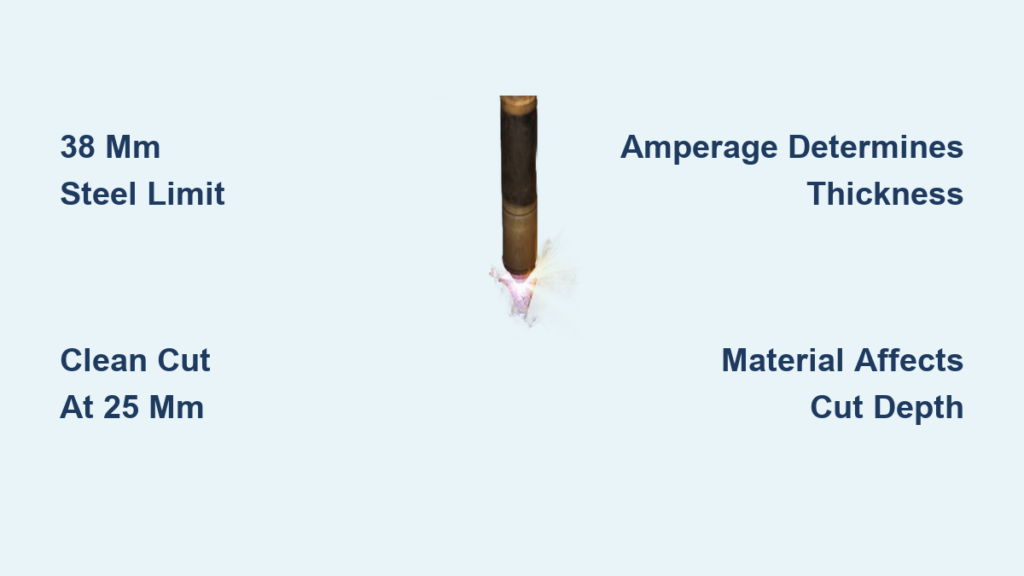
Your handheld plasma cutter’s maximum capability hits a hard ceiling at 38 mm (1.5 inches) of mild steel thickness. This isn’t a recommendation—it’s a physical limitation where the plasma arc simply can’t maintain penetration through thicker material. Most DIY and professional workshop units fall into this category, making this the critical threshold for 95% of users.
Clean Cut vs. Rough Sever Capability
Achievable clean cuts: For smooth, dross-free edges requiring minimal cleanup, limit cuts to 25 mm (1 inch) or less regardless of your machine’s maximum rating. Beyond this point, edge quality deteriorates rapidly as the plasma arc struggles to maintain consistent penetration through the entire thickness.
Material-specific limitations: Your 38 mm maximum drops to 32 mm for stainless steel and plummets to 28 mm for aluminum due to their different thermal properties. Aluminum’s high thermal conductivity pulls heat away from the cutting zone faster, while stainless steel’s composition creates more resistance to the plasma arc.
Warning: Attempting cuts beyond your machine’s capability doesn’t just create poor results—it rapidly destroys electrodes and nozzles. Each failed thick cut costs you $15-$50 in consumables that could have lasted dozens of thinner cuts.
Industrial Plasma Systems Maximum Thickness
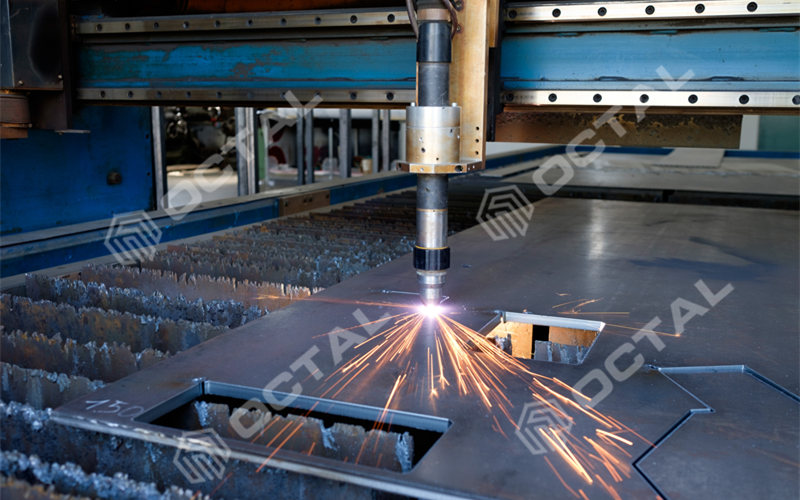
Industrial CNC plasma cutters push the boundaries to 150 mm (6 inches) of steel thickness, but these aren’t machines you’ll find at your local hardware store. These heavy-duty systems cost tens of thousands of dollars and require specialized infrastructure that makes them impractical for most workshops.
Power and Infrastructure Requirements
Electrical demands: Cutting 150 mm steel requires 400+ amp machines running on three-phase industrial power. Your standard 220V workshop outlet can’t supply the massive current needed for these extreme thicknesses—most industrial units require dedicated 480V circuits.
Cooling system differences: While your handheld unit uses air cooling, industrial systems employ sophisticated water injection systems that stabilize the plasma arc through extreme thicknesses. Without this specialized cooling, the plasma arc would destabilize when cutting beyond 50 mm.
Amperage-to-Thickness Relationship Decoded

Your plasma cutter’s amperage rating directly determines maximum thickness capability through a predictable relationship that applies across all machine types. This isn’t marketing speculation—it’s physics governing plasma arc energy density.
Specific Amperage Thickness Guidelines
- 30 amp units: Maximum 12 mm (0.5 inches) steel with clean cuts limited to 8 mm
- 50 amp units: Maximum 20 mm (0.8 inches) steel with quality cuts up to 15 mm
- 100 amp units: Maximum 40 mm (1.6 inches) steel with clean cuts around 30 mm
- 200 amp industrial units: Maximum 75 mm (3 inches) steel with production-quality cuts at 60 mm
Real application example: If you regularly cut 25 mm steel plate, a 50 amp machine will struggle while a 100 amp unit handles it with ease. The extra amperage provides the sustained arc energy needed for complete penetration without excessive dross formation.
Material Type Impact on Maximum Thickness
Your machine’s thickness rating assumes mild steel—switch materials and the game changes significantly. Thermal properties and electrical conductivity dramatically affect how thick you can cut before the plasma arc fails.
Metals That Cut Thicker Than Rated
Stainless steel: Actually cuts slightly better than mild steel at extreme thicknesses due to its excellent thermal conductivity. Your 38 mm maximum might extend to 40 mm with stainless when using proper gas settings.
Aluminum: High conductivity helps penetration but creates different challenges. While aluminum cuts faster than steel at equivalent thicknesses, its softness causes more dross buildup that requires specialized techniques.
Problematic Materials That Reduce Thickness Capability
Lead and copper: Poor electrical conductivity in these materials creates significant cutting challenges. Most plasma cutters struggle with lead regardless of thickness, while copper requires specialized high-frequency starting systems.
Critical warning: Never attempt to cut non-conductive materials like wood, plastic, or ceramics—plasma cutting requires electrical conductivity to complete the circuit. Trying will damage your machine without producing any cut.
Performance Reality at Maximum Thickness
Operating at your machine’s absolute thickness limit comes with significant trade-offs that affect both your timeline and final results. Understanding these realities prevents frustration when your 38 mm cut doesn’t match the clean precision of thinner material.
Quality and Speed Degradation Patterns
Edge quality collapse: Clean, perpendicular cuts become beveled and irregular as you approach maximum thickness. Expect significant dross (molten metal residue) on the bottom edge requiring extensive grinding to clean up.
Dramatically slower cutting speeds: Cutting 38 mm steel takes 5-10 times longer than 12 mm material at the same amperage. Your 20-inch cut that takes 2 minutes on thin material might require 15-20 minutes on maximum thickness.
Consumable destruction: Electrodes and nozzles wear out 3-5 times faster when operating at maximum thickness capacity. Budget for replacing consumables after just a few thick cuts rather than the dozens you’d get on thinner material.
Practical Thickness Guidelines for Quality Results
Rather than pushing your machine to its absolute limit, work within optimal ranges that balance cut quality, speed, and consumable life. This approach delivers better results with less frustration and lower long-term costs.
Recommended Working Thickness Ranges
- 30 amp machines: Stick to 10 mm or less for quality work without excessive dross
- 50 amp machines: 15 mm provides the best balance of speed and edge quality
- 100 amp machines: 25-30 mm maintains excellent productivity with minimal cleanup
- 200+ amp industrial units: 50-60 mm keeps cut quality acceptable for most applications
Pro tip: Always cut a test piece on scrap material before committing to your actual project. A quick test reveals your specific machine’s real-world capabilities with your technique and material—manufacturer specifications often assume perfect conditions you won’t encounter in your workshop.
Cost vs. Thickness Reality Check for DIY Users

The jump from handheld to industrial plasma cutting represents an enormous financial commitment that rarely makes sense for occasional thick material work. Most DIY users never justify the expense of 150 mm-capable systems when outsourcing remains more economical.
Budget Considerations
Handheld units: $500-$2,500 delivers reliable cutting up to 38 mm thickness
Industrial systems: $15,000-$100,000+ required for 100-150 mm capability
Operating costs: Industrial machines consume 5-10 times more electricity and gas
Smart decision point: If you only occasionally need cuts over 38 mm, partnering with a local fabrication shop proves far more cost-effective than investing in industrial equipment. Most shops charge $50-$150 per hour for plasma cutting services—far less than the capital investment required.
Quick Reference Thickness Capability Chart
| Amperage | Max Steel Thickness | Clean Cut Thickness | Typical Applications |
|---|---|---|---|
| 30 amps | 12 mm | 8 mm | Hobby projects, light repairs |
| 50 amps | 20 mm | 15 mm | Automotive fabrication, gates |
| 100 amps | 40 mm | 30 mm | Structural steel, heavy fabrication |
| 200 amps | 75 mm | 60 mm | Industrial maintenance, ship repair |
| 400 amps | 150 mm | 125 mm | Shipbuilding, heavy structural |
Final Thickness Considerations for Your Projects
Your plasma cutter’s thickness limit isn’t just about raw capability—it’s about balancing quality, speed, and economics for your specific application. Most DIY and small shop projects rarely exceed 25 mm steel thickness, making standard handheld units perfectly adequate for real-world needs.
Critical takeaway: Match your machine choice to your actual project requirements rather than maximum specifications. A properly sized 50 amp unit delivering clean 20 mm cuts consistently outperforms both an underpowered 30 amp machine struggling with the same thickness and an overpowered 200 amp unit wasting resources on small jobs. Test cuts on your specific material before committing to project work, and remember that clean, quality cuts within your machine’s optimal range beat rough, problematic cuts at maximum capacity every time.