
That wobbly cut from your last plumbing attempt still haunts you—water pooling under the sink because your pipe wouldn’t seat properly in the fitting. The culprit? Probably improper cutting technique. Mastering how to use a copper pipe cutter transforms frustrating plumbing repairs into clean, leak-proof connections in under a minute. Whether you’re installing a new dishwasher line or crafting copper art, this precision tool delivers professional results without the vibration and mess of a hacksaw.
Unlike power tools that generate heat and sparks, a copper pipe cutter works through controlled pressure and rotation, creating a perfectly square cut that slides smoothly into fittings. This guide reveals the insider techniques professionals use to achieve flawless cuts every time—no special skills required. You’ll learn space-saving tricks for cramped under-sink jobs, how to spot a dull blade before it ruins your pipe, and why that final deburring step makes the difference between a temporary fix and decades of reliable service.
Select the Right Copper Pipe Cutter for Your Workspace
Standard Versus Compact Designs
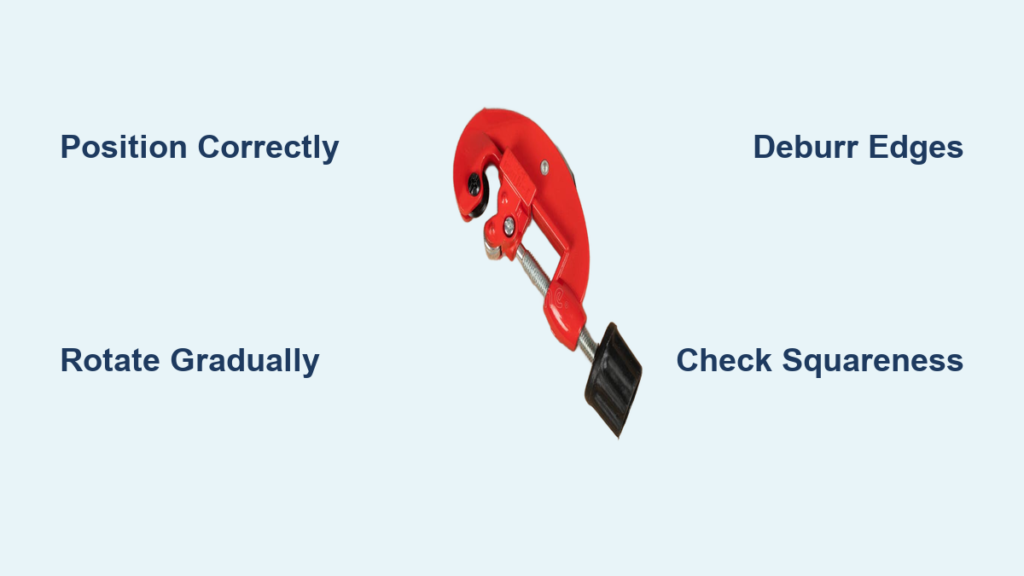
Standard C-shaped cutters provide maximum leverage with their comfortable grip, making them ideal when you have room to rotate the tool completely. These excel for bench work, new installations, and situations where precision matters most. The ergonomic handle reduces hand fatigue during multiple cuts, while the larger frame delivers consistent pressure that prevents pipe deformation.
Handleless variants sacrifice leverage for access, becoming indispensable when working in tight spaces under sinks or behind appliances. These compact tools fit where standard cutters can’t, often operating in spaces as narrow as half an inch. Though they require more hand strength, their slim profile solves the most common problem DIYers face—insufficient clearance for tool rotation.
Match Cutter Size to Pipe Diameter
Residential plumbing primarily uses 1/2″, 3/4″, and 1″ copper pipes, so verify your cutter accommodates these standard sizes. An oversized cutter on small pipe creates uneven pressure and angled cuts, while an undersized tool simply won’t clamp properly. Check the cutter’s capacity range before purchasing—most quality models handle 1/8″ to 1″ pipes, covering 95% of household projects. When in doubt, measure your pipe’s outside diameter with calipers for absolute accuracy.
Secure Your Workspace Before Cutting
Essential Safety Preparations
Protect yourself first: Slip on cut-resistant gloves to shield against razor-sharp copper burrs that form during cutting. Safety glasses are non-negotiable—metal shards can fly unexpectedly when the pipe separates. Add a dust mask if using power-assisted cutters to avoid inhaling fine copper particles.
Prepare the pipe: For installed plumbing, shut off the water supply completely and open the lowest faucet to drain residual water. Even a small amount of trapped water creates messy drips that compromise cut quality. For bench work, clamp the pipe firmly with wooden jaws to prevent vibration—any movement during cutting creates angled, unusable sections.
Position the Cutter for Perfect Alignment

Initial Placement Technique
Slide the copper pipe cutter around your pipe exactly at the cut line. Rotate the adjustment knob clockwise until the cutting wheel barely contacts the copper surface—you should feel slight resistance but see no indentation. This critical positioning stage determines your cut’s squareness; any angle here multiplies into a crooked end that won’t seal properly in fittings.
Create the Guiding Groove
With the cutter positioned, rotate it one full revolution around the pipe. You’ll feel the blade carve a shallow groove that serves as your cutting track. This groove prevents blade wandering during the main cut. If the groove appears off-center, loosen the knob immediately and reposition—the correction window closes once you apply significant pressure.
Execute the Cut with Professional Technique
Progressive Cutting Method
The secret to clean cuts lies in small, incremental pressure:
- Tighten the adjustment knob one-eighth turn clockwise
- Rotate the cutter 2-3 full revolutions around the pipe
- Repeat the tighten-rotate sequence until separation
Critical warning: Never crank the knob aggressively. Over-tightening crushes the pipe into an oval shape that won’t fit properly in solder or compression fittings. Copper’s softness means gentle, consistent pressure yields superior results than brute force.
Recognize Cut Completion
You’ll feel the cut finish through distinct physical feedback—the cutter suddenly spins freely with no resistance as the pipe separates. A quality cut shows square edges (90 degrees to pipe length), minimal deformation, and smooth interior walls requiring only light finishing. If separation feels rough or jagged, your blade is likely dull and needs replacement.
Finish Edges for Leak-Proof Connections
Deburring Process
Even perfect cuts need finishing to prevent future leaks. Start with a dedicated deburring tool—insert into the pipe opening and twist clockwise to remove the internal burr that would otherwise slice O-rings or catch debris. Follow with 220-grit sandpaper around the exterior edge, creating a slight bevel that guides fittings into place smoothly. Skip this step, and you risk damaged seals that leak immediately or fail prematurely.
Quality Verification Checklist
Before proceeding to assembly, examine your cut under good lighting:
– Squareness test: Place a carpenter’s square against the cut—any visible gap indicates an angle
– Burr check: Run a finger around edges—should feel uniformly smooth with no snags
– Deformation inspection: Roll the pipe on a flat surface—wobble indicates crushing
Conquer Tight Spaces Under Sinks

Space Assessment Strategy
Measure your working area before selecting tools:
– Standard cutters need at least 2 inches of clearance for full rotation
– Handleless models operate in spaces as narrow as 0.5 inches
– Auto-cut tools require just 1.3 cm behind the pipe but match specific diameters exactly
Pro tip: Use a flexible measuring tape to determine available rotation space before committing to a tool. Attempting to force a standard cutter in tight quarters often damages nearby pipes or fittings.
Alternative Tools for Impossible Spaces
When no manual cutter fits, consider an oscillating multi-tool with a fine-tooth metal blade as a last resort. Cut slowly to minimize heat buildup, then expect significant deburring—power tools often leave rough, uneven edges that compromise seal integrity. For frequent tight-space work, invest in a dedicated auto-cut tool that snaps around the pipe without rotation requirements.
Troubleshoot Cutting Problems Immediately

Fix Crushed Pipe Edges
Symptom: Pipe ends flattened into oval shapes that won’t fit in fittings
Cause: Over-tightening the adjustment knob between rotations
Solution: Replace the cutting wheel, use smaller pressure increments, and maintain consistent hand pressure throughout rotation
Correct Angled Cuts
Symptom: Cut face not perpendicular to pipe length, causing gaps in fittings
Cause: Uneven pressure application or pipe movement during cutting
Solution: Re-clamp the pipe more securely using padded jaws, and rotate the cutter with steady, even pressure
Address Dull Blade Issues
Warning signs: Requiring excessive knob tightening, poor cut quality, visible nicks on cutting wheel
Critical action: Replace the cutting wheel immediately—dull blades create dangerous situations through unpredictable breakage and poor control
Maintain Your Cutter for Decades of Service
Essential Daily Care
After each use:
– Wipe clean with a dry cloth to remove copper particles that accelerate corrosion
– Lubricate moving parts with light machine oil to prevent binding
– Inspect blade for nicks or chips that compromise cut quality
– Store dry to prevent rust on precision components
Know When to Replace Components
Replace cutting wheels when:
– Cuts require noticeably more pressure than before
– Visible damage appears on the cutting edge
– Cut quality degrades despite proper technique
– After approximately 500 cuts for standard residential use
Mastering how to use a copper pipe cutter separates amateur plumbing attempts from professional-quality results. The key lies in incremental pressure adjustments, sharp blades, and patience—never force the cut. Remember that final deburring step, as it transforms a technically adequate cut into a leak-proof connection that will last decades. Keep your cutter clean and lubricated, and it will deliver precision cuts through hundreds of projects. Whether you’re fixing a leaky faucet supply line or creating custom copper fixtures, these techniques ensure every cut seats perfectly in its fitting, saving you time, materials, and the frustration of repeated repairs. Your next plumbing project doesn’t have to end with a puddle under the sink—start with a perfect cut and build your success from there.